Every rule, revised for clarity and reorganized so you can find an answer mid-game — plus a full glossary and the official card index. Search for any term, card, or mechanic below.
Showing rules for the base game.
Playing with the first expansion? Click above, or see what's new with Fatesworn →
Premise: Each player is competing to become a deity of legend in this strategic free-for-all. You'll align with one of four mystical Fates, build a glorious Temple, gather Faithful followers, and collect powerful Relics — all from a central Marketplace. Your Faithful battle through opposing Temples in a Raiding Party, and if they reach the Heart of a Temple, a channel opens to Smite your opponent, damaging their life force and bringing you one step closer to immortality.
How to Win: Reduce every opponent from 20 Life Points to zero, or collect all four Fate Relics of the same type (Chaos, Grace, Prosperity, or Wisdom) to win at the start of your next turn.
Playing with Fatesworn? +Fatesworn There's a third path to victory: hold all four Relics of the Fates at the start of your turn.
A full card-by-card breakdown of every Faithful, Relic, Tile, and Fate Card — with exact quantities — is in the Card Index at the end of this page.
Give each player:
Then, to prepare the shared Marketplace:
Choose your Heart Tile pool. Fatesworn adds 6 unique alternate Heart Tiles, each with its own face-up ability, to use in place of the original Heart. Agree on one pool before dealing out starting Temples:
Assigning the Tiles (if using the 6- or 7-tile pool): either shuffle the pool and deal one Heart Tile to each player at random (recommended for new players), or draft them: place the whole pool A-side up and pass all of it to the player going last in turn order. That player secretly chooses one Tile, then passes the rest to the player on their right (counter-clockwise). That player chooses one and passes the remainder on, and so on, until the player going first has taken their Tile. Any Tiles nobody took are set aside face-down — every chosen Heart Tile's B-side stays secret until it's revealed in play.
Once assigned, place your Heart Tile A-side up in your Temple as normal, with its Life Counter set to 20.
Every turn has four steps, always in this order:
| Step | What Happens |
|---|---|
| I. Reveal | Restock the Marketplace with one new Faithful and one new Relic. |
| II. Marketplace | Play Faithful for gold, buy cards and Tiles, rearrange your Temple — in any order, any number of times. |
| III. Raid (optional) | Send your Raiding Party against one opponent's Temple. |
| IV. Reinforce | Collect all your Faithful and reassign them to Temple or Raiding Party for next turn. |
You may take any of the following actions, in any order, as many times as you like:
Choose one opponent and send your Raiding Party to attack their Temple, fighting your way toward their Heart Tile. Full mechanics are in Raiding & Combat.
Collect every Faithful you have — whether they're in your Discard Pile, your Temple, or came back from a Raid — and split them into two face-down groups for next turn:
Faithful in your Temple can collect gold and Defend, but cannot Raid. Faithful in your Raiding Party can only Raid — they can't collect gold or Defend. Set your Raiding Party Marker on top of your face-down Raiding Party to keep the two groups straight.
The Marketplace is the shared board where Tiles, Faithful, Relics, and Fate Cards are all acquired. Its Faithful and Relic rows are restocked one card at a time during each player's Reveal Step. When a row is full, the current player covers any card in that row to make room — but only the top card of any resulting pile (and the top Tile of the Tile Deck) is ever available to buy.
Tiles are the building blocks of your Temple. Each player starts with the same five Starting Tiles and can buy more from the shared Tile Deck. Tiles bought from the deck are blank two-doorway hallways on their A-side — you won't know what's on the B-side (a Room, a Trap, or just a well-connected hallway) until you pay to flip it.
 Flip Cost Flip Cost | How much gold it costs to flip this Tile from its A-side to its B-side. On Starting Tiles the cost is printed on the A-side; on Tile Deck Tiles it's hidden on the B-side until you buy and flip it. |
 Combat Bonus Combat Bonus | Adds to the Defending player's Combat Roll during a Raid — but only while the Tile is being actively Defended. If every Defending Faithful on that Tile is removed from combat, the bonus disappears and the Tile is conquered. |
 Station Station | A defensible position. Each Station lets you house one Faithful in your Temple, so more Stations mean a bigger Temple hand and better defense. |
 Altar Altar | Lets you house one Fate Relic face-up in your Temple. An Altar with no Relic on it is simply "empty." |
The 25-card Tile Deck contains 8 Trap Tiles, 6 unique Room Tiles (each with just 1 doorway but a special ability), and 11 connecting Tiles with 2–3 doorways. More than half of the deck has Stations; only 8 Tiles have Altars. Some Tiles let you search the Relic Deck for a specific Relic when flipped — you're never required to find one.
The Tile Deck holds 4 different Trap Tiles. Traps stay on their A-side and spring automatically — for a one-time effect — the moment a Raiding Party Marker lands on them; flipping is not optional once triggered. A Trap has no further effect on later Raids, with one exception: the Ambush Trap has a Station icon and can go on to be used as a Defensive position. A Raiding Party can't retreat in response to a Trap springing, but its controller can still play Fate Cards or other actions in response.
Faithful are your followers — the cards that populate your two hands: your Temple and your Raiding Party. They're reusable turn after turn unless something sacrifices them (sacrificed Faithful go to the bottom of the Faithful Deck). Every player starts with the same four: 2 Guards, 1 Acolyte, and 1 High Priest, all beginning in the Temple and ready to collect gold on turn one.
"Playing" a Faithful means placing it face-up from your active hand (Temple or Raiding Party) to trigger its effect, after which it's temporarily discarded. You'll play Faithful in several situations:
Everything you play during your turn sits in a temporary Discard Pile until your Reinforce Step, when it's collected and reassigned. Faithful that Defended during a Raid return straight to your Temple at the end of that Raid.
The shared 60-card Faithful Deck (separate from the Guard/Acolyte supply used at setup) costs between 2 and 5 gold per card to acquire, and breaks down into three tiers:
Devotees are a special Basic Faithful: the first one you play in a turn collects just 1 gold, but each additional Devotee you play that same turn collects one more than the last (1, then 2, then 3, and so on). Devotees also combo with each Fate's Shrine Relic for extra effects.
Relics are the powerful tools and ancient artifacts of the world of Foretold. One is revealed into the Marketplace every turn from the 40-card Relic Deck, and purchased Relics sit face-up beside your Tiles.
Basic Relics (8 types, 24 in the deck, gray banner) have no Fate alignment — own as many as you like, with no restriction.
Fate Relics (16 in the deck — a Crown, Shield, Shrine, and Sword for each of the four Fates) each require an open Altar to house. You may only have one Fate's Relics in your Temple at a time, but Fate Relics unlock two things: they let you play more powerful Fate Cards of the same alignment (see Relic Cost), and collecting all four of one Fate wins you the game outright.
The Fatesworn expansion adds four more Relics — the Crucible, Ring, Scepter, and Vestments of the Fates. All four are Basic Relics — no Altar required.
If you start your turn holding all four Relics of the Fates, you win the game immediately — there's no Altar requirement, and it stacks with the base game's own alternate win condition above.
They come with real risk, though: if you're ever Smited while holding any Relics of the Fates, you lose control of all of them at once, and your Smiter acquires them — triggering each Relic's normal "on acquire" ability for its new owner. Holding the full set makes you a target.
Of the four, only the Crucible of the Fates carries a Fate affiliation of its own — it counts as a Relic of every Fate type, letting you play any Fate Card as though its Relic Cost were reduced to 1, like a permanent Scroll. The Ring, Scepter, and Vestments have no Fate affiliation.
You can activate a Relic's ability as an Action any time it's legally playable. Some Relics have a cost baked into their ability (a Shrine, for example, requires sacrificing a Devotee from your Discard Pile), and you can use them any time that cost can be paid — during your Marketplace Step, or even mid-Raid if a Devotee was just defeated. Others depend on game state (a Runestone, for instance, needs a die roll already on the table to trigger off of).
Many Basic Relics are sacrificed on use — meaning after their ability resolves, they go to the bottom of the Relic Deck.
You may only house one Fate's Relics in your Temple at a time, but you can switch. If you currently hold a Wisdom Relic and want a Chaos Relic instead, you must first return every Wisdom Relic you own to the Marketplace (no refund) before acquiring the Chaos Relic. When you return a Fate Relic this way, place it on any empty Relic Row spot, or cover another Relic if the row is full.
Before there were gods, there were the Fates — ancient influences guiding all forces, seen and unseen. Each of the four Fate Decks plays very differently:
Each Fate Deck has 30 cards: 15 with no Relic Cost, 9 with a Relic Cost of 1, 5 with a Relic Cost of 2, and 1 with a Relic Cost of 3.
A Fate Card's Relic Cost — shown by the Fate symbols in its top-right corner — is the number of matching Fate Relics you must have in your Temple to play it. Own 2 Wisdom Relics, for example, and you can play any Wisdom Fate Card with a Relic Cost of 2 or less. Some Relics or Fate Cards reduce a card's Relic Cost by 1 or more, letting you play above your current Relic count; a few cards waive the Relic Cost entirely.
Any time you use an ability on a card or Tile you own, it's an Action — and every opponent gets a chance to respond before it resolves. Actions include:
Buying is not an Action — nobody can respond to, or interrupt, a purchase from the Marketplace.
Once you're ready, use your Raiding Party to attack one opponent's Temple per turn. Your Raiding Party Marker starts at their Entrance and advances Tile by Tile toward their Heart. Every Tile with a Station triggers a battle — one or more Defending Faithful (one per Station) against however many Raiding Faithful you choose to dispatch. Win, and the Tile is conquered for the rest of the Raid, letting your party move freely onto the next adjacent Tile. Conquer the Heart Tile, and you get to Smite your opponent.
When Faithful fight, roll one combat die per Faithful played (some cards call for extra dice — Warrior and Demigod, for example). Roll everything at once, then assign one result per Faithful — you choose the assignment, so assign strategically (a low roll to a Faithful whose Combat Bonus benefits most from it, for instance).
Combat Bonuses — printed on many Faithful and Tiles — add straight to that side's total. Multiple bonuses stack. A player's full Combat Roll is the sum of every assigned die plus every active Combat Bonus.
Resolving a Combat Roll: the higher total wins; a tie always goes to the Defender. If a Faithful (or the Tile itself) is removed from combat — discarded or sacrificed — before the roll is final, its Combat Bonus and die result come off the total immediately, and the total is recalculated. No Combat Roll is final until every player at the table — even those not directly in the fight — agrees no one has any more responses to play.
If a Raid ends in retreat, your dispatched Raiding Faithful simply go to your discard pile — at your next Reinforce Step, you collect all of your Faithful (win or lose) and reassign them to Temple or Raiding Party as normal. There's no separate penalty beyond the failed attack itself.
The moment your Raiding Party conquers the Heart Tile, recall one Faithful as usual, then Smite the Defender:
Certain cards and Tiles can add even more damage to a Smite Roll. Cards that trigger specifically "on Smite" (Vandal, or any of the four Crown Fate Relics) resolve after the damage lands.
A Raid ends the moment a player either retreats or Smites their opponent. The Defender's Faithful — played or defeated — all return to their Temple. The Raiding Player then moves on to their Reinforce Step.
Every player starts with 20 Life Points — the maximum. Cards that "Heal" restore lost Life Points but can never push you above 20; if you're already at full health, a Heal effect simply does nothing (you aren't considered "Healed" unless it actually restores something). Damage can also be "Prevented" by some cards — in that case no Life Points are ever lost, and it isn't Healing either.
Elimination: when a player's Life Points hit zero, they're out of the game. Their Relics and any non-starting Faithful are shuffled back into the shared Marketplace decks — but their Temple Tiles stay exactly as placed on the table and are not returned to any deck.
Victory is achieved the moment either win condition is met: you're the last player standing, or you collect all four Relics of a single Fate (confirmed at the start of your next turn). Playing with Fatesworn adds a third path: holding all four Relics of the Fates at the start of your turn. +Fatesworn
Foretold's open design invites house rules and variants — some are small tweaks, others add a whole new twist. The current library of community and designer variants lives at foretold-game.com; agree on any variant as a table before your game begins, and feel free to submit your own.
Every term used consistently throughout this page, alphabetically.
The full, official component list — every card in the box, by name and quantity.
Click a category, then click a name to see the card.
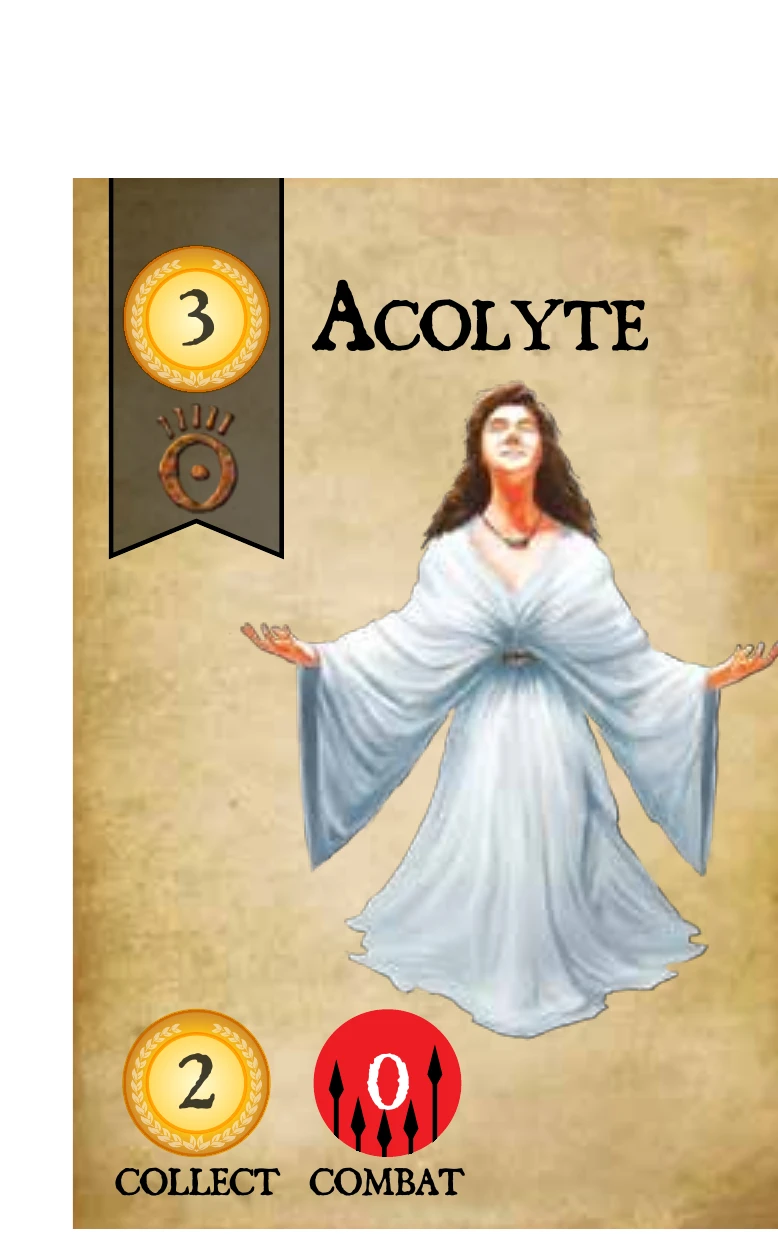
Acolyte
Game Design: Jay Semerad
Graphic Design: Neal Rasmussen
Faithful and Relic Art: Garrett Post
Rules Document: Jay Semerad
Rules Document Editing: Orin Kennedy
Card Rules Text & Editing: Rob McKenzie, Jay Semerad
Additional Game Design: Morgan Burns
May the Fates reward your devotion, and aid you in your quest for immortality.